


Small scale M&Is a PPA necessary even in A? Cases where it can be omitted, simple handling, and how to explain it to the audit firm
Small scale M&Can A's PPA be omitted? In conclusion, if the buyer is a company that has undergone an accounting audit (a listed company, a large company under the Companies Act, an IPO preparation company, a subsidiary of a listed company, etc.), PPA (Purchase Price Allocation) is necessary regardless of the size of the acquisition price.Business combination accounting standardsThis is because there is no minimum amount. On the other hand, if the buyer is a small and medium-sized company that has not undergone an accounting audit, it is unlikely that a PPA will be requested in practice.
However, "required" and "required full work" are two different things. small size M&In A's PPA, the scope of work can be narrowed down significantly by using the simple treatment of book value as market value and the judgment of materiality in identifying intangible assets.
In this article, small M&We will organize the types of buyers who require A's PPA, two simple procedures to narrow down the work, a two-step process to reduce costs, and how to explain it to the auditing firm.
Small scale M&Whether A's PPA is necessary depends on whether or not the buyer conducts an audit.
Business combination accounting standards apply not only to listed companies but also to stock companies that prepare financial statements in accordance with generally accepted business accounting standards, and there are no exemptions based on the purchase price. If the company becomes a subsidiary through stock acquisition, PPA will be required on the consolidated financial statements, and if it is a merger or business transfer, PPA will be required on the individual financial statements. In other words, from an accounting perspective, projects worth tens of millions of yen and projects worth tens of billions of yen are treated the same. Accounting auditing is the process of confirming whether or not this is necessary for accounting purposes.
On the other hand, small and medium-sized enterprises that have not undergone an accounting audit are allowed to use simple procedures based on the "Guidelines for Accounting for Small and Medium-sized Enterprises." In addition, for mergers and business acquisitions, accounting treatment is often based on tax treatment (asset adjustment account, difference liability adjustment account), and there are almost no practical situations in which a PPA in accordance with business combination accounting standards is required.
| buyer typology | small scaleM&AofPPA | supplement |
| Listed companies and IFRS compliant companies | need | Required regardless of acquisition amount. The issue is “how far should we go?” |
| Non-listed companies undergoing accounting audits (large companies under the Companies Act, subsidiaries of listed companies, companies affiliated with PE funds, etc.) | need | Auditor confirms PPA implementation status |
| IPO preparation company | need | In addition to acquisitions from the previous two periods, past acquisitions with residual goodwill and intangible assets are also confirmed. |
| Small and medium-sized enterprises that have not undergone an accounting audit | not required in practice | Tax treatment is the basis. If you are looking to IPO or becoming a large company in the future, make certain arrangements at the time of acquisition. |
You can narrow down the work even if it is “necessary”: Small scale M&Simple handling of PPA of A
Two requirements for book value to be considered market value
Small scale M&Even if A's PPA is required, it does not mean that all assets and liabilities must be strictly evaluated at market value. Business combination accounting standardsApplicable pointer item 54allows book value to be considered fair value if both of the following two conditions are met:
- The acquired company has calculated the appropriate book value of assets and liabilities in accordance with generally accepted corporate accounting standards as of the day before the business combination date.
- The difference between its carrying amount and its market value at the date of the business combination is not expected to be material.
2One requirement is the ``and'' relationship. In other words, it is not enough that the difference is small; the target company's books must be properly prepared in accordance with accounting standards. small size M&For companies subject to A, this first requirement is often a problem.
- The target company has not undergone an accounting audit and its books are prepared based on tax standards (e.g., unrecorded reserves, tax standards for depreciation, etc.)
- The target company's books do not reflect off-the-books debts and overstatement of assets pointed out in the financial DD.
- The target company is a foreign company and only has books based on local accounting standards.
Therefore, in such cases, it is necessary to correct the books in accordance with accounting standards before considering the book value as market value. In this case, the results of the financial DD are useful as a starting point for corrections.
Determining materiality in identifying intangible assets
Regarding the identification of intangible assets, it may be determined not to record them if they are of little monetary significance. However, the auditing firm will ask for ``the basis for determining that it is not material.'' ``Not considering it'' and ``considering it but it is not important'' are completely different from an audit perspective.
Specifically, we consider the types of intangible assets that can be identified and their approximate impact based on the purpose of the acquisition, the target company's business model, and the size of the difference between the acquisition price and book value of net assets, and document the results. In cases where the difference in price is small, the target company has just been established, or the acquisition purpose is human resources or synergies, the identified intangible assets are small and there is room for a simple approach. On the other hand, if the difference is large and the target company has a continuous customer base or brand, it will be difficult to get the audit firm to accept the conclusion that the difference is "immaterial."
Small scale M&How to proceed with A's PPA in two stages
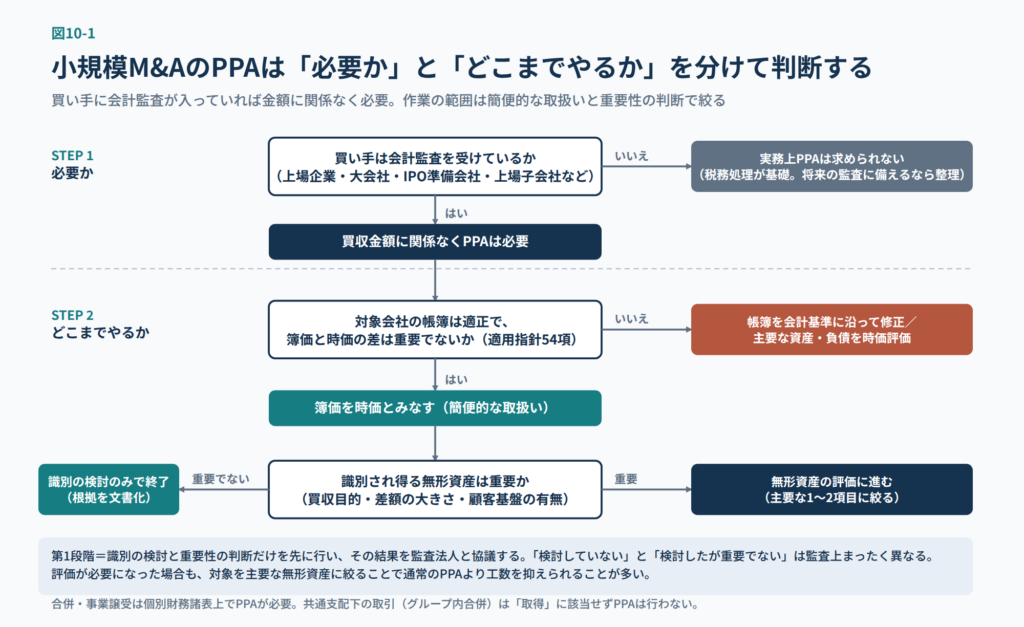
Figure 10-1 Small M&How to proceed with A's PPA. Decide whether it is necessary or not and how far you should go.
For projects with an acquisition price of several hundred million yen or less, the outsourcing costs of PPA can be felt to be relatively heavy. Therefore, rather than requesting a full-scale evaluation all at once, it is more realistic to proceed in two stages: first, only ``considering the identification of intangible assets and determining their importance,'' and proceeding to evaluation only when it is determined that there are important intangible assets. If it is only the first stage, the cost will be limited and the results will serve as explanatory materials for the audit firm.
The first step is to organize the following:
- Purpose of acquisition and business model of target company
- Hypothesis about the difference between the acquisition price and book value and the main contents of the difference (customer base, brand, technology, human resources, synergies)
- Types of intangible assets that can be identified and their approximate impact
- Items for which book value is considered fair value and proposals for items to be evaluated at fair value
- Conclusion (identify/determine that it is of little importance) and its basis
Furthermore, even if it is determined in the first stage that there are important intangible assets, by narrowing down the evaluation to one or two main items, the man-hours can often be reduced compared to normal PPA.
Small scale M&How to explain A's PPA to the audit firm
As a general rule, the scope of simple handling should be discussed with the audit firm before starting the evaluation work. small size M&A typical case where A's PPA is disputed with an auditing firm is a case where it is discovered just before the closing date that ``identification has not been considered.'' Therefore, we recommend that you gather the following information and prepare for negotiations at an early stage before or after closing.
- Transaction overview: Acquisition form, acquisition ratio, acquisition amount, closing date
- Overview of target company: industry, business model, book value and net assets, presence or absence of accounting audit, book preparation standards
- Results of financial DD (off-the-books debts, differences in accounting policies)
- Results of the first stage examination (identifiable intangible assets, judgment of materiality, and basis thereof)
The results of the discussions will be documented in minutes or via email. It will be useful as a basis for judgment at the time when the auditor is later replaced or during an IPO examination.
Things to be careful about in small-scale mergers and business transfers
PPA when a company becomes a subsidiary through stock acquisition is treated in the consolidated financial statements, but in transactions where the target company's assets and liabilities are directly accepted, such as a merger or business acquisition, a PPA is required in the individual financial statements. Furthermore, since it is treated as an asset adjustment account (5-year amortization) for tax purposes, it is necessary to organize it from both an accounting and tax perspective, such as the tax effect resulting from the difference between the accounting goodwill amortization period and the goodwill amortization period. We recommend working with a tax advisor.
Please note that mergers between group companies under the control of the same shareholder (transactions under common control) do not fall under the category of "acquisition" under business combination accounting standards, and a PPA is not performed because the acquisition is carried out at book value.
The IPO preparation company was a small M in the past.&A is also confirmed
IPO preparation companies will be required to provide audited financial statements for the last two years when applying for listing, and business combinations conducted during those periods will be subject to audit. Furthermore, even if the acquisition occurred in an earlier period, if goodwill and intangible assets remain on the balance sheet at the time of application, the validity of the PPA at that time will be confirmed. Therefore, in the early stages of IPO preparation, it is important to take inventory of past acquisitions and&Regarding A's PPA, we recommend that you discuss with the audit firm whether it is necessary or not and whether it can be handled simply.
summary
Small scale M&To summarize A's PPA, if the buyer is a company that has undergone an accounting audit, a PPA is required regardless of the acquisition price. On the other hand, if the buyer is a small to medium-sized company that has not undergone an accounting audit, there are almost no practical requirements. Even if it is necessary, if the bookkeeping is appropriate and the difference is not significant, the book value can be treated simply as the fair value, and the materiality can also be determined when identifying intangible assets. However, it is essential to document the ``grounds considered'' and discuss them with the audit firm in advance. If you use a two-step approach where you first consider identification and proceed to evaluation only when necessary, you can respond to audits while keeping costs down.
Things you can discuss with Keystone Advisory
At Keystone Advisory, we ask about the outline of the transaction (whether or not the buyer has been audited, the type of transaction, the difference between the acquisition price and the book value of net assets), and then at the initial consultation stage, we tell you whether or not a PPA is necessary, whether simplified handling is possible, and how to organize it for discussion with an audit firm. small size M&A's PPA also responds to requests for "identification consideration only" in stages.Contact formPlease contact us from.
References
Accounting Standards for Business Combinations (Corporate Accounting Standards No. 21)
Writer
Kensuke Tanabe (CPA)
Keystone Advisory
Engaged in valuation/PPA work, statutory audits, and IPO support at Tohmatsu Audit Corporation and PwC Advisory. He assumed his current position after working as a director at a PE fund and an issuer at an operating company.
*This article is a general explanation based on the accounting standards at the time of writing, and the necessity or non-necessity of each company will differ depending on the circumstances of each company and discussions with the auditing firm.
