


How to determine the discount rate (WACC) under the DCF method | Points checked by size premium, country risk, and auditing firms
The basic method for determining WACC is to take a weighted average of the cost of equity and the cost of debt after tax based on the market value-based capital structure. Of the WACC (weighted average cost of capital), which is the discount rate of the DCF method, the cost of shareholders' equity is calculated by adding size premium, etc. as necessary to the risk-free interest rate + β × equity risk premium. Each element has standard sources in practice (government bond yields, risk premium reports such as Ibbotson, β of similar listed companies).
The audit firm checks the consistency between the source, reference date, selection of comparable companies, double counting of premiums, stock price calculation and PPA/impairment test. When evaluating overseas companies, the general rule is to match currency and inflation assumptions for cash flows and discount rates, and to factor in country risks only once.
In this article, we will explain how to determine WACC, including the approach and sources for each component, the handling of country risk in evaluating overseas companies, and points to be checked by audit firms. WACC is the discount rate used to calculate business value by discounting free cash flow attributable to both shareholders and creditors (FCFF).
Overall picture of how to determine WACC: Structure of WACC
First, WACC is the weighted average of the cost of equity and cost of debt (after tax) based on the market value-based capital structure (interest-bearing debt D and equity E).
WACC = E/(D+E) × Cost of equity + D/(D+E) × Cost of debt × (1 - Effective tax rate)
Next, in practice, the cost of shareholders' equity is generally calculated using the following formula based on the capital asset pricing model (CAPM).
Stockholder capital cost = risk-free rate + β × equity risk premium (+ size premium, etc. depending on the scale and situation of the evaluation target)
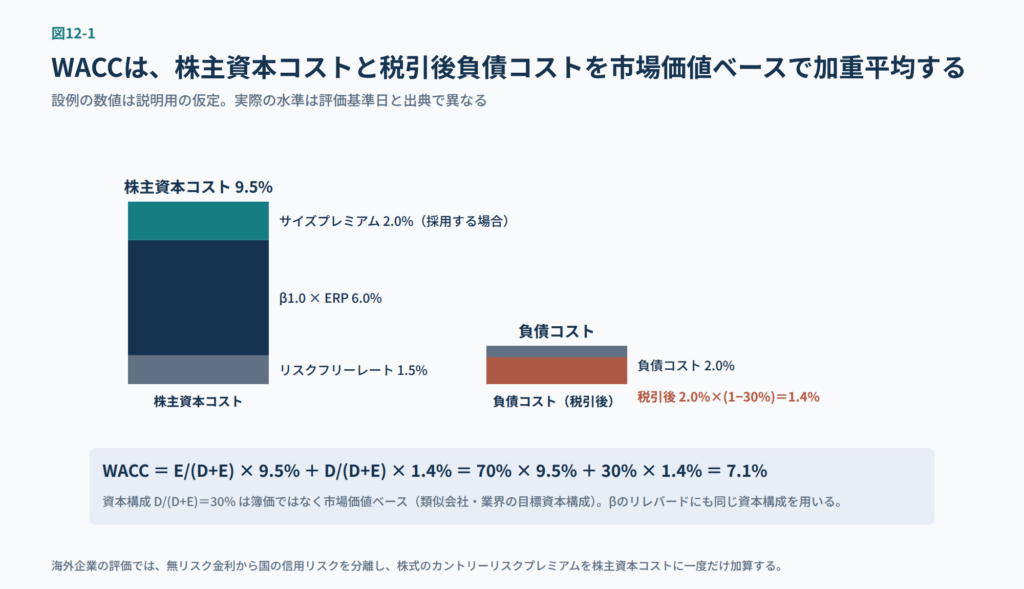
Figure 12-1 WACC configuration (illustrative example). Figures are illustrative assumptions; actual levels will vary depending on reference date and source.
Therefore, below we will look at the ideas and practical sources for each element.
How to determine WACC: Concept and source of each element
risk free rate
信用リスクがない投資の利回りとして、国債の利回りを用います。 Yen-denominated valuations of Japanese companies often use the 10-year Japanese government bond yield, which is the yield on the valuation reference date (published by the Ministry of Finance and the Japan Securities Dealers Association).また、事業計画の期間や継続価値の前提に合わせて、より長期の国債を採用する考え方もあります。基準日と出典を明記し、算定書の中で一貫して使うことが重要です。 Note that government bonds cannot always be considered risk-free, and the adjustment described below is required for government bonds of countries where credit risk is factored into the yield.
Equity Risk Premium (ERP)
株式市場全体が国債を上回って要求する超過リターンです。 There are two methods: one method is based on past market performance (historical ERP), and the other is based on future expectations (implied ERP). In Japan, it is common practice to use annual reports based on past market data (such as Ibbotson Associates Japan's Japanese version of the ERP report) as sources. Since auditing firms often refer to the same sources, the source and the version (year) of the figures used should be clearly stated.
Beta (β)
評価対象事業の株価が市場全体に対してどの程度連動するかを示す係数です。 When evaluating unlisted companies, we obtain the betas of listed companies in the same industry (similar companies), average the betas after removing the influence of each company's financial leverage (unlevered), and then re-leverage the betas in accordance with the capital structure of the company being evaluated (releveraged). The selection criteria for similar companies (business content, scale, region), observation period (weekly for 2 years, monthly for 5 years, etc.), and data source will be stated in the valuation report.
size premium
It is a premium added to the cost of equity based on empirical research showing that small company stocks command higher returns compared to larger companies. Regarding the Japanese market, size premium reports calculated by market capitalization size (such as the Japanese version of the Size Premium Report by Ibbotson Associates Japan) have been published. If adopted, use numerical values in categories according to the scale of the evaluation target.
ただし、サイズプレミアムの加算は自動的な必須要件ではありません。 We will make a decision on whether to accept or reject a company based on the scale of the evaluation target, the size difference with similar companies, and the degree to which risks are incorporated into the business plan, and the reason for selection and how to choose the size category will be written in the calculation report. In addition, the audit firm may ask you about the selection of size categories and the double counting of premiums (are you looking at the same risk twice in β and other premiums?).
Other premiums (company-specific risks)
Additional premiums may be added due to dependence on specific customers, dependence on key persons, uncertainty of business plans, etc. However, it is difficult to quantitatively demonstrate the basis for this, and audit firms tend to point out that ``shouldn't the risks of the business plan be reflected in the cash flow estimate rather than the discount rate?'' Therefore, if you add it, we recommend that you clearly state the reason and show the impact in a sensitivity analysis.
debt cost
This is the interest rate when the subject of evaluation takes out a new loan. Specifically, it is calculated by adding the credit spread to the target company's actual borrowing rate, the corporate bond yield of companies with similar creditworthiness, and the risk-free rate. Note that interest paid is a deductible expense for tax purposes, so it is used after tax (×(1 - effective tax rate)).
Capital composition (D/E ratio)
It is common to use the average of similar companies or industry standard level (target capital structure) based on market value rather than book value, rather than the actual capital structure being evaluated. Evaluations from a market participant's perspective assume a reasonable capital structure for the company operating the business, rather than a specific buyer's financing method. It also needs to match the capital structure used to relever the beta.
How to determine WACC for overseas companies: consider risk-free interest rate, national credit risk, and stock country risk separately
For example, when a Japanese company evaluates a foreign company such as Indonesia, it constructs a discount rate by distinguishing between the following three factors:
- Risk-free interest rate: Yield that does not include credit risk. Local currency-denominated government bond yields may include the credit risk of the country's sovereign (government), so they cannot be treated as risk-free interest rates. Therefore, it is estimated by deducting the default spread (additional margin based on the rating) of government bonds, or by adding the difference between the inflation rates of the two currencies to the risk-free interest rate of the base currency.
- Country credit risk (default spread): Addition to the government's default risk. Relates to estimating the cost of debt.
- of stockCountry Risk Premium (CRP): The additional return demanded by investors for stocks operating in a country. It is estimated by adjusting the default spread by stock market volatility, and academic institutions publish country-specific estimates. It is added to the cost of shareholders' equity (there is also the idea of adjusting the amount of addition depending on the exposure of the business to risks).
How to choose a valuation currency
After this, decide in which currency the evaluation will be constructed. Since cash flow denominated in local currency (Rupiah, etc.) incorporates the local inflation rate, the discount rate is also calculated in local currency (risk-free interest rate that reflects the local inflation rate), and CRP is added separately to the cost of equity.
On the other hand, when evaluating in a base currency (such as the US dollar), CRP is added to the risk-free interest rate of the base currency and the ERP of the mature market, and cash flows are converted using consistent exchange rate assumptions using the difference in inflation rates between the two countries. In other words, it is not a choice between valuing in the local currency or adding CRP, but the principle is that national risk is factored in only once in the cost of equity, regardless of which currency is used for valuation.
Inconsistencies that are likely to be pointed out by audit firms
What is important is to match the currency/inflation assumptions for the cash flows with the currency/inflation assumptions for the discount rate, and to avoid doubly incorporating country risk into both the conservative cash flow estimate and the discount rate premium. For example, audit firms point out inconsistencies such as applying a yen-denominated discount rate to a rupiah-denominated business plan, or treating government bond yields as risk-free interest rates and then adding the full amount of CRP.
Points to be checked by auditing firms regarding how to determine WACC
| Confirm items | typical questions |
| Source and reference date | What is the source of each parameter? Is the data as of the evaluation reference date? Is the report version up to date? |
| Risk-free interest rate and country risk (overseas companies) | Does the risk-free interest rate include national credit risk? Isn't CRP double factored into cash flow and discount rate? |
| Selection of similar companies | What are the selection criteria? Are the business contents, scale, and region similar to those to be evaluated? Reason for excluded companies |
| Beta processing | Is the calculation of unrelevard and relevard correct? Reason for selection of observation period. Handling outliers |
| size premium | Is the size classification appropriate? Is there any double counting with other premiums? |
| Capital composition | Is it based on market value? Do you use the same capital structure for beta relevard and WACC weighting? |
| Integration | Are different discount rates used for the same company in stock price calculations, PPAs, and impairment tests? Reason if using |
| Comparison with IRR (PPA) | How is the difference between IRR and WACC calculated backwards from the acquisition price explained? |
| Relationship with perpetual growth rate | Is the perpetual growth rate of continuing value reasonable compared to the discount rate (within the long-term inflation rate and economic growth rate)? |
| Sensitivity analysis | Is the range of appraisal value shown when the discount rate and perpetual growth rate are varied? |
Practical points to note when determining WACC
- Prioritize consistency: If the method of calculating the discount rate for the same valuation target changes without reason for stock price calculation, PPA, and next year's impairment test, it will be difficult to explain this to the audit firm. Therefore, once a method is decided, the parameters should be updated every year, and if the business risk or capital structure changes significantly, the method itself should be reviewed and the reasons should be recorded.
- Keep the calculation process: The source of each parameter, acquisition date, and calculation formula are left on the discount rate calculation sheet. That way, it can be reproduced even if the person in charge changes, and it will be effective in impairment tests from the following year onwards.
- Show sensitivity analysis as a set: There is a reasonable range of discount rates. For example, a sensitivity analysis using a data table can illustrate the robustness of your conclusions by showing the range of valuations for combinations of discount rates and perpetual growth rates.
- Do not adjust the risk of the business plan using the discount rate: If there are concerns about the achievability of the business plan, it is a general rule to respond by analyzing scenarios or reviewing the business plan itself.
summary
To summarize how WACC is determined, WACC is calculated from the risk-free rate, equity risk premium, beta, size premium (if adopted), cost of debt, and capital structure based on market value. Each has its own standard sources and ideas for practice.
Furthermore, when evaluating overseas companies, it is essential to distinguish between risk-free interest rates, national credit risk, and country risk of stocks, to match currency and inflation assumptions for cash flows and discount rates, and to factor in country risk only once. Furthermore, in order for the audit firm to confirm the source, reference date, selection of similar companies, double counting, consistency, and consistency with the IRR, it is important to clearly state the calculation process and basis in the valuation report and demonstrate the robustness of the conclusion through sensitivity analysis.
Things you can discuss with Keystone Advisory
At Keystone Advisory, we calculate discount rates for stock price calculations, PPAs, and impairment tests, prepare sources and supporting materials for each parameter, and provide explanations to audit firms. We also accept consultations on how to determine WACC, such as reviewing WACC calculated in-house and how to reflect country risk in evaluations of overseas companies including Indonesia.Contact formPlease contact us from.
References
Damodaran, Country Default Spreads and Risk Premiums(NYU Stern)
Japan Institute of Certified Public Accountants “Corporate Value Evaluation Guidelines”
Writer
Kensuke Tanabe (CPA)
Keystone Advisory
Engaged in valuation/PPA work, statutory audits, and IPO support at Tohmatsu Audit Corporation and PwC Advisory. He assumed his current position after working as a director at a PE fund and an issuer at an operating company.
*This article is an explanation based on general evaluation practices at the time of writing. The specific values for each parameter vary depending on the evaluation reference date and source.
