


What is PPA (Purchase Cost Allocation) | M&Reasons why it is necessary after A, target acquisition, and what will happen if it is not implemented
What is PPA?&This is an accounting procedure in which the acquisition price paid in A is allocated to the acquired company's assets and liabilities at the market value as of the date of business combination, and the remaining amount that cannot be allocated is determined as "goodwill." It is an abbreviation for Purchase Price Allocation in English, and is called "allocation of acquisition cost" in Japanese.
This is required when a company that prepares financial statements applying Business Combination Accounting Standards (Japanese GAAP) or IFRS 3 conducts an "acquisition" such as stock acquisition, business transfer, or merger. The deadline is one year from the date of business combination. Because profit and loss, impairment testing, and disclosure for several years after an acquisition are all based on this procedure, it is important to decide how to proceed early before and after closing.
In this article, we will first explain how PPA works with examples and diagrams. Then, from the perspective of the person in charge at the buyer company, we will clarify which companies and transactions require it, what will happen to the financial statements if it is implemented, and what problems will arise if it is not implemented.
What is PPA?|Acquisition cost allocation mechanism
Accounting Standards for Business Combinations (Corporate Accounting Standards No. 21)Paragraph 28 of the Act provides for the allocation of acquisition costs as follows: "Among the assets and liabilities accepted from the acquired company, those that are identifiable as of the date of the business combination (identifiable assets and liabilities) will be allocated to those assets and liabilities within one year after the date of the business combination, based on the market value as of the date of the business combination."
The key point is that goodwill is not directly calculated as the difference between the acquisition price and net assets. Goodwill is determined as the remainder after allocation to assets and liabilities. Because of this order, the procedure is called "allocation of historical costs."
Example: Allocation of acquisition amount 150
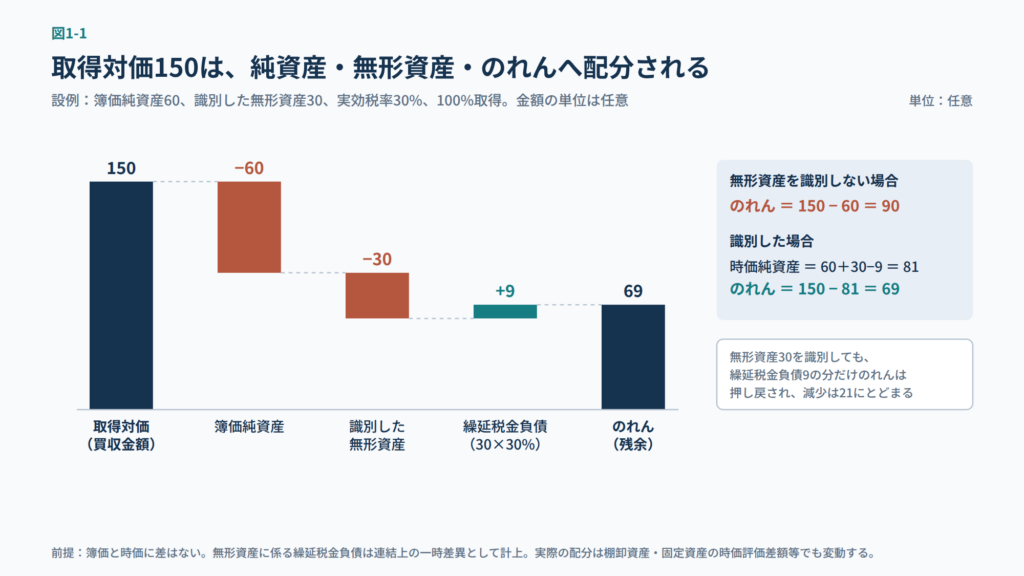
Figure 1-1 Allocation of acquisition consideration (illustrative example). Units are arbitrary. These are illustrative figures assuming intangible assets of 30, effective tax rate of 30%, and 100% acquisition.
Assume that the target company's balance sheet has assets of 100 and liabilities of 40 (book value and net assets of 60), and that you acquire 100% of the company's stock at 150. Assume there is no difference between book value and market value, an intangible asset (customer relationship) 30 is identified in the PPA, and the effective tax rate is 30%.
Figure 1-1 Allocation of acquisition consideration (illustrative example). Units are arbitrary. These are illustrative figures assuming intangible assets of 30, effective tax rate of 30%, and 100% acquisition.
If we do a simple calculation without identifying intangible assets, goodwill is 150 - 60 = 90. In PPA, the assets and liabilities listed on the balance sheet are first revalued at market value. In addition, intangible assets (such as customer relationships, trademarks, technology, etc.) that are not on the balance sheet are identified and marked to market.
When intangible assets 30 are recorded, a deferred tax liability 9 (30 x 30%) is also recorded for the difference between the consolidated book value and the tax book value. As a result, the market value of net assets is 60 + 30 - 9 = 81, and the goodwill is 150 - 81 = 69. The breakdown of the acquisition price of 150 was visualized as ``30 intangible assets, 69 goodwill, and 60 net assets (81 after considering tax effects)''.
Common misconception: PPA = not intangible asset valuation
In practice, a request to ``please provide a PPA'' is often used to mean ``please evaluate intangible assets.'' The valuation of intangible assets has a large monetary impact within a PPA and requires the involvement of experts, so this usage itself is natural.
However, to be precise, PPA is a series of procedures that includes calculation of acquisition cost, valuation of tangible assets and liabilities, identification and valuation of intangible assets, tax effects, and calculation of goodwill. Intangible asset valuation is only part of this. You can avoid confusion later by separating out the scope of the process to be entrusted to an external valuation expert and the scope to be handled by your company's accounting department.
3 steps of PPA
- Calculation of acquisition cost: Determine the market value of the consideration paid. If the consideration is cash, the amount is clear, but if there is stock consideration or conditional consideration (earn-out), there are issues that need to be confirmed. Acquisition-related costs such as FA fees and DD costs are treated as expenses when incurred in the consolidated financial statements and are not included in acquisition cost (Business Combination Accounting Standard, Paragraph 26). On the other hand, as a general rule, incidental expenses are included in the acquisition cost of subsidiary stocks in individual financial statements. Please note that the handling is different for consolidated and individual items.
- Market value evaluation of identifiable assets and liabilities: Assets and liabilities recorded on the balance sheet (inventories, fixed assets, retirement benefit obligations, etc.) are revalued at market value. We also identify and evaluate intangible assets that are not recorded on the balance sheet. This also includes consideration of specific accounts related to business combinations (expenses expected to be incurred after the acquisition that are reflected in the calculation of consideration).
- Calculation of goodwill: The remaining amount after subtracting the net market value of identifiable assets and liabilities from the acquisition cost is determined as goodwill (or negative goodwill if it is negative). Under Japanese GAAP, the determination of the amortization period for goodwill and the allocation to business units for impairment testing are also considered at this stage.
The valuation expert is primarily responsible for Step 2, which is identifying and evaluating intangible assets (in some cases, valuing movable assets such as machinery and equipment). Steps 1 and 3, accounting procedures and preparation of notes, are mainly carried out by the accounting department of the buying company. If the company has been audited, this will be determined after consultation with the auditing firm.
Which companies and transactions require a PPA?
The necessity of a PPA is not determined by whether the company is listed or unlisted or the size of the acquisition price. This is determined by the accounting framework used to prepare financial statements, the type of transactions, and whether consolidated financial statements are prepared.
Applicable accounting framework
Business combination accounting standards apply to all stock companies that prepare financial statements in accordance with generally accepted business accounting standards. Companies applying IFRSIFRS No. 3(Business combination).
In practice, companies that are subject to accounting audits are effectively required to apply this standard. Specifically, this applies to listed companies, large companies under the Companies Act, IPO preparation companies, and companies that are required by financial institutions or parent companies to provide audited financial statements.
Transaction form and consolidation/individual
| Form of transaction | PPAfinancial statements that require | supplement |
| Becoming a subsidiary through stock acquisition (100% acquisition or acquisition of control) | Consolidated financial statements | In the individual financial statements, the stock is only recorded at acquisition cost as subsidiary stock, and no intangible assets or goodwill appear. |
| Business transfer | Separate financial statements (and consolidation) | Directly accept the assets and liabilities of the target business |
| Acquisition of business through absorption-type merger or company split | Separate financial statements (and consolidation) | If it falls under "acquisition". Transactions under common control are not covered. |
| Acquisition of shares to become an equity method company | Consolidated financial statements (equity method) | Accounting standards require market valuation and identification of intangible assets. |
Reorganizations within the same group (transactions under common control) and the formation of jointly controlled enterprises do not fall under "acquisitions" and are not subject to PPAs.
What happens to your financial statements when you implement a PPA?
A PPA is more than just an accounting procedure; it affects the post-acquisition profit and loss for several years. The following four points are particularly important for those in charge of business planning and finance at the purchasing company to understand.
1. Amortization of intangible assets occurs
Identified customer-related and technology assets are amortized over their useful lives. It is often thought that only a portion of goodwill is replaced by intangible assets, but the useful life of intangible assets does not necessarily match the amortization period of goodwill, and the pattern of amortization expense changes.
For IFRS companies, goodwill is non-amortized, while intangible assets with finite lives are amortized. Therefore, the results of PPA directly affect the level of operating income (under IFRS, intangible assets with indefinite useful lives are not amortized but tested for impairment every fiscal year).
2. The amount of goodwill and amortization period are determined (Japanese standards)
Under Japanese GAAP, goodwill is regularly amortized over its effective period of up to 20 years (Accounting Standard for Business Combinations, Paragraph 32). Although goodwill decreases when intangible assets are identified in the PPA, goodwill partially increases due to the recording of deferred tax liabilities related to intangible assets.
As in the example, if the amortization period for intangible assets and goodwill is the same, the total amortization expense will be higher than when no intangible assets are identified. These are numbers that need to be factored into next year's budget and medium-term management plan.
3. There may be a temporary impact on profit and loss immediately after the acquisition.
If inventories are revalued at market value, the cost of goods sold will increase when they are sold after an acquisition, and the gross profit margin will temporarily decline. The same applies to changes in depreciation expenses due to revaluation of tangible fixed assets, recognition of favorable and unfavorable contracts, etc. It is important to explain this in advance so that management, looking at the business results immediately after the acquisition, does not misunderstand that the acquired company's profitability is worse than expected.
4. Provides the basis for impairment testing and disclosure
Goodwill is subject to an impairment test if there is an indication of impairment after the acquisition (every period under IFRS). Determining which business unit (cash-generating unit) to attribute goodwill to at the PPA stage is a prerequisite for determining impairment later.
In addition, notes regarding business combinations in securities reports and financial statements disclose the details of the allocation of acquisition costs (the amount of goodwill, the breakdown of intangible assets, and the number of years of amortization, etc.).
What happens if you don't implement a PPA?
We are sometimes asked, "Since goodwill is the difference in amount, wouldn't the result be the same even if we do not identify intangible assets?" The answer is, both in terms of accounting standards and in practice, it's not the same.
- Conflict with Accounting Standards: Business Combination Accounting Standards Section 29 requires (but does not optionally) treat intangible assets, such as legal rights, as identifiable if they involve separate and transferable intangible assets. For companies undergoing an audit, the auditor will confirm whether the intangible assets that should have been identified have been considered. If the conclusion is ``As a result of consideration, there were no significant intangible assets,'' it may be accepted, but ``Not considered'' is not acceptable.
- Overdue: The allocation must be completed within one year from the date of the business combination. If the accounting period crosses over, provisional accounting treatment will be applied and then adjustments will be made retroactively to the date of the business combination at the time of finalization.
- Adjustments to financial statements and increased man-hours: If you are asked to identify intangible assets at the end of an audit, you will have to carry out evaluation and audit response simultaneously during the financial settlement schedule. Both the burden on staff and external costs will increase.
- IPO screening/internal control issues: At IPO preparation companies, the application status of business combination accounting is confirmed during screening. From the perspective of internal control over financial reporting, it is important to check whether accounting processes for non-routine transactions such as business combinations are in place.
- Difficult to explain when impaired: If the contents of goodwill are not sorted out in the PPA, when signs of impairment appear, it will not be possible to explain why the consideration paid was impaired. Determining and measuring impairment is also difficult.
Standard PPA flow and required period
Our standard time period is approximately two months from the start of the work by the valuation expert to the presentation of the calculation results, and approximately three months including the review by the auditing firm. It varies depending on the size of the target company, the number of businesses, the number of intangible assets identified, and whether or not valuation of tangible fixed assets is necessary.
| step | Main work | guideline |
| Prepare | Selection of valuation experts, policy consultation with auditing firms, receipt of material request list, sharing of DD/stock price calculation materials | 2~3 weeks |
| identify | Hearing about the purpose of the transaction and business details, identification of intangible assets, and agreement on the scope of evaluation | 2~3 weeks |
| evaluation | Analysis of business plans, evaluation of intangible assets and tangible assets, draft reports | 3~4 weeks |
| Audit response | Responding to questions from audit firms (and evaluation experts on the audit firm side) and finalizing reports | 3~4 weeks |
| accounting treatment | Creation, provisional processing or finalization of journal entries, tax effects, and notes | According to the closing date |
The appropriate time to start depends on the closing schedule, the next year's budget, the status of the closing balance sheet, and the PMI load.
Cost of PPA
The cost of intangible asset valuation outsourced to a valuation expert is generally between 2 million yen and several million yen for small to medium-sized projects in Japan, according to published fee examples. In cases where the acquisition consideration is in the billions of yen and multiple intangible assets are valued, some explanations indicate that the acquisition price should exceed 10 million yen.
The amount is determined by the number and type of intangible assets identified, the number of businesses of the target company, whether property, plant and equipment valuation is required, and the scope of the audit firm's support.
Things to check first for your own project
- Check the accounting framework that your company applies (Japanese GAAP or IFRS, whether it has undergone an accounting audit), the type of transaction (stock acquisition, business transfer, merger), and whether consolidated financial statements have been prepared, and identify the financial statements that require a PPA.
- If the company is undergoing an accounting audit, consult the auditing firm at an early stage before or after closing regarding how to proceed with the PPA (identification policy for intangible assets, necessity of provisional treatment, involvement of valuation experts).
- When outsourcing the identification and evaluation of intangible assets to external valuation experts, proceed with the selection and preparation of materials in a systematic manner.
- The amortization costs incurred as a result of the PPA and the temporary impact on profit and loss immediately after the acquisition will be factored into the next fiscal year's budget and explanation to management.
Things you can discuss with Keystone Advisory
At Keystone Advisory, we work together with the accounting and corporate planning departments of the buying company to identify and evaluate intangible assets in PPAs, deal with audit firms, and consider accounting treatments. We provide consultations before starting work, such as ``Does your project require a PPA?'' ``What intangible assets are likely to be identified?'' ``Will it be possible to meet the closing date?''
We also handle PPAs for cross-border projects, such as the acquisition of an Indonesian company by a Japanese company.Contact formPlease let us know the outline of the transaction (type of acquisition, timing, accounting standards).
Writer
Kensuke Tanabe (CPA)
Keystone Advisory
Engaged in valuation/PPA work, statutory audits, and IPO support at Tohmatsu Audit Corporation and PwC Advisory. He assumed his current position after working as a director at a PE fund and an issuer at an operating company.
*This article is a general explanation based on accounting standards as of September 2026, and the numerical values in the examples have been simplified for easier understanding. Individual accounting treatments vary depending on the circumstances of each company and consultation with the audit firm.
