



Difference between corporate value and stock value | Which is the acquisition price? What is deducted from net debt? How to read the stock price calculation report
To put it simply, the difference between corporate value and stock value is that "stock value" corresponds to the purchase price of the stock. The DCF method, which discounts free cash flows attributable to both shareholders and creditors (FCFF) using WACC, directly calculates "business value." The stock value is calculated by adding assets not used in business (non-business assets) and surplus cash, and subtracting interest-bearing debt, debt-like items, and non-controlling interests.
For example, in the example, business value 1,000 + non-business assets 80 + surplus cash 50 - interest-bearing debt 300 - debt-like items 60 - non-controlling interests 20 = stock value 750. If you include cash in both "non-business assets" and "net debt," it will be double-added, so each item should only be added or subtracted once.
In this article, in order to understand the difference between corporate value and stock value, we will explain the relationship between the three values, adjustment items from business value to stock value, what is included in net debt, what value the acquisition price corresponds to, and where to look in the stock price statement.
Difference between corporate value and stock value: relationship between three values
As a premise for sorting out the difference between corporate value and stock value, the usage of terms differs slightly depending on the literature and practitioners, but the Japanese M&AIn practice, it is generally organized as follows.
- Business value: The present value of the future cash flows generated by a company's operations. It is this amount that is directly calculated using the DCF method, which discounts free cash flows attributable to both shareholders and creditors (FCFF) by WACC.
- Enterprise value (EV): Next, the value of business value plus the value of assets not used in business (non-business assets) and surplus cash. It is the value of the company as a whole and belongs to both shareholders and creditors.
- Equity value: The value attributable to shareholders, which is calculated by subtracting the portion attributable to creditors (interest-bearing debt, debt-like items, non-controlling interests) from the corporate value. It is this amount that corresponds to the purchase price of the shares.
Formula for calculating stock value
Written as a formula, it looks like this: In this article, in order to avoid double addition of cash, surplus cash is not included in "non-business assets" and is listed separately.
Stock value = Business value + Non-business assets (excluding surplus cash) + Surplus cash - Interest-bearing debt - Debt-like items - Non-controlling interests
When using FCFE and fluctuations in terminology
The DCF method also includes a method that directly calculates stock value by discounting cash flow attributable to shareholders (FCFE) by the cost of shareholders' equity. In this case, the above deduction will not be made because the interest-bearing debt adjustment has already been made in the cash flow. This article assumes the method of discounting FCFF using WACC, which is common in practice.
In addition, in practice, many people use "corporate value" to mean business value, and EV in the EV/EBITDA multiple using the comparable company comparison method is usually calculated as market capitalization + net debt. When reading a calculation report or FA document, first check how each term is defined in the document.
See the difference between corporate value and stock value with examples
Calculate from business value to stock value using the following assumptions (units are arbitrary). Please note that each adjustment item is not included in cash flow under the DCF method.
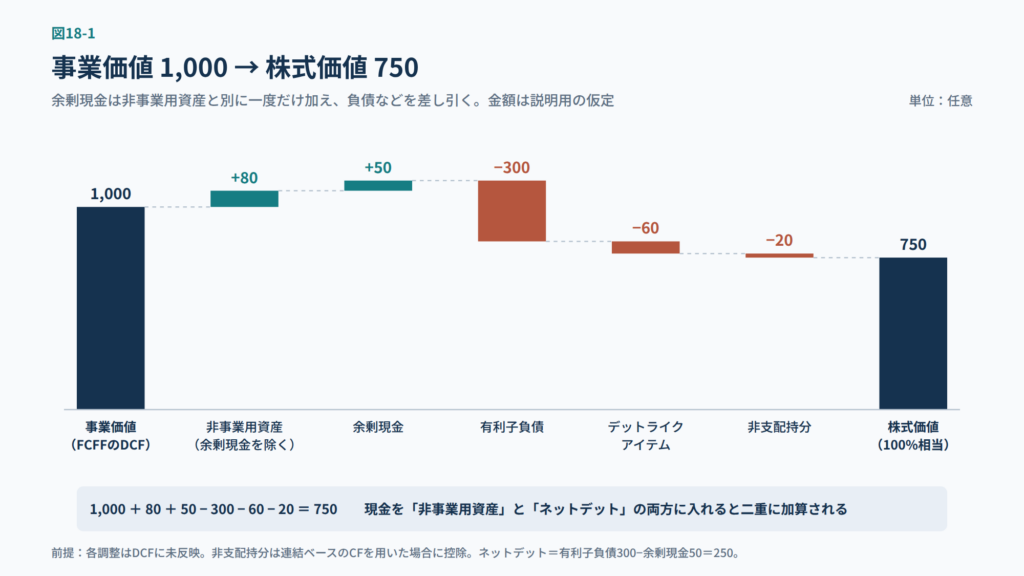
Figure 18-1 Increase/decrease from business value to stock value (illustrative example, units are arbitrary). 1,000+80+50-300-60-20=750. Cash should not be included in both ``non-business assets'' and ``net debt,'' but only added once.
| project | amount | explanation |
| Business value (DCF method) | 1,000 | Sum of the present value and continuing value of the business plan's free cash flows |
| Non-business assets (excluding surplus cash) | +80 | Market value of assets not used in business, such as idle real estate, investment securities, and loans. |
| surplus cash | +50 | The portion of cash and deposits excluding the minimum balance necessary for business operations. There are some arrangements for including them in non-business assets, but they are included only once in either category. |
| corporate value | 1,130 | 1,000+80+50 |
| interest-bearing debt | -300 | Borrowings, bonds, lease obligations |
| dead-like items | -60 | Unfunded retirement benefit obligations, unpaid dividends, reserves for disputes, unpaid corporate taxes, etc. |
| non-controlling interest | -20 | If the cash flow of the entire subsidiary is included in the cash flow of the DCF method, the portion attributable to minority shareholders of the subsidiary is deducted. |
| Stock value (100%) | 750 | Basics of stock purchase price |
In this example, the DCF method result (business value) is 1,000, but the stock value that is the basis for the stock purchase price is 750. Conversely, if a company has no debt and has plenty of surplus cash, the value of its stock will exceed the value of its business.
What is attracted by net debt that makes the difference between corporate value and stock value?
Net debt is interest-bearing debt minus excess cash. In the above example, interest-bearing debt 300 - surplus cash 50 = 250 is net debt, and debt-like items 60 are added to this to give 310, which is the total debt side that is deducted from business value and non-business assets. In practice, buyers and sellers argue over the range, and it is not uncommon for the amount to vary from tens of millions of yen to hundreds of millions of yen.
What is included in interest-bearing debt?
- First, borrowings (short-term and long-term), corporate bonds, and discounted bills.
- Lease obligations (finance leases; basically all leases under IFRS)
- Accrued interest
Debt-like items (deducted according to debt)
Next, although it is not an interest-bearing debt in accounting terms, any future cash outflow that is certain and is not included in the cash flow of the business plan is deducted from the stock value in the same manner as debt. Typical examples are:
- For example, unfunded portion of retirement benefit obligations, reserve for directors' retirement benefits, etc.
- In addition, provisions related to unpaid corporate taxes and tax risks are also provided.
- Contingent liabilities related to disputes, guarantees, and environmental measures that are likely to occur
- Accrued dividends and amounts payable to shareholders
- Delinquent accounts payable and accrued, accrued expenses that exceed normal levels
- Deferred revenue (advance payments) that involves fulfillment costs (handling depends on the project)
- Accounts payable for capital investments, asset retirement obligations
Range of surplus cash (distinction from cash-like items)
- The minimum amount of cash and deposits required for business operations (the amount that needs to be kept as working capital) is generally removed from surplus cash. This is because it is considered part of the working capital required to calculate business value.
- Restricted deposits and deposits pledged as collateral are also excluded from surplus cash.
- Loans that are certain to be recovered, insurance reserves, etc. may be added in the same way as cash (cash-like items). In the example, these are included in non-business assets 80.
In other words, what is included in net debt is determined by consistency with what is factored into the cash flow of the business plan. For example, if retirement benefit payments are included in the personnel expenses of a business plan, if you separately deduct the retirement benefit obligation, it will result in a double deduction.
What value does the acquisition price correspond to?
In a stock acquisition, the acquisition price (stock consideration) corresponds to the stock value. However, M&In negotiations for A, a method is widely used in which a price is agreed upon on a ``corporate value basis'' and the stock consideration is adjusted according to the level of net debt and working capital at the time of closing (cash-free/debt-free price presentation). Therefore, it is first necessary to confirm whether the "acquisition price" offered by the seller and FA is based on corporate value or stock value. If you don't understand the difference between corporate value and stock value, you could end up with a misunderstanding worth hundreds of millions of yen.
On the other hand, in the case of a business transfer, the assets and liabilities of the target business are transferred individually, so the transfer price usually corresponds to the business value (including transferred working capital and fixed assets), and interest-bearing debt is not transferred.
How to read the stock price valuation report based on the difference between corporate value and stock value
When you receive the stock price valuation report, first check the following points:
- Definition of value: How are business value, corporate value, and stock value defined, and what values do the results of the DCF method indicate?
- Reconciliation (bridge) from business value to stock value: Next, each item and amount of non-business assets, surplus cash, interest-bearing debt, debt-like items, and non-controlling interests, and the date of the balance sheet on which they are based.
- Consistency of valuation reference date and adjustment item reference date: Also, is the valuation reference date of the DCF method and the date of the balance sheet used for calculating net debt misaligned?
- 1Calculation of value per share: number of outstanding shares, deduction of treasury stock, treatment of potential shares such as stock options and class shares.
- Consistency with the comparable company comparison method: Furthermore, is the adjustment from corporate value calculated using the EV/EBITDA multiple to stock value made using the same items and amounts as adjustments made using the DCF method?
- Control-based or minority-based: Does evaluation assume dominance?
Common misconceptions about the difference between corporate value and stock value
- The DCF method amount is not the acquisition price: The result of the DCF method using FCFF is the business value, and the stock value after adjusting for net debt is the basis of the stock consideration.
- ``Companies with a large amount of cash and deposits are expensive'' is half true: It is true that cash and deposits push up the stock value, but the amount necessary for business operations cannot be deducted, and it is necessary to consider whether you are buying cash and deposits at a high price that will flow out due to dividends or repayments immediately after an acquisition.
- "Net assets on the books = stock value": Net assets on the books are the accumulation of past acquisition costs and do not reflect the profitability of the business. The market value and net assets method, which revalues assets to market value, may be the main method for companies that primarily own real estate or securities, for companies that are premised on liquidation, or for cases where the business plan is unreliable. The DCF method and similar company comparison method are used depending on the purpose of evaluation and the characteristics of the business.
- It is not "just use the numbers in the financial statements for net debt": The scope of debt-like items is determined individually based on the results of financial DD and the premises of the business plan.
summary
To summarize the difference between corporate value and stock value, business value is the value of the business calculated directly using the DCF method, which discounts FCFF by WACC, and corporate value is the value of the entire company, including non-business assets and surplus cash. Stock value is the value attributable to shareholders after deducting interest-bearing debt, debt-like items, and non-controlling interests, and it is the stock value that corresponds to the purchase price of the stock. It is important to add or subtract each item only once and not to put cash in both non-business assets and net debt.
In addition, the scope of net debt is determined based on consistency with the cash flow of the business plan, including not only interest-bearing debt but also debt-like items such as retirement benefit obligations, accrued taxes, and contingent liabilities. In the stock price calculation report, check the definition of value, the bridge from business value to stock value, alignment of record dates, and treatment of potential shares.
Things you can discuss with Keystone Advisory
At Keystone Advisory, in addition to creating stock price valuation reports, we also explain how to read the valuation reports we receive and organize net debt and debt-like items. We can also verify whether the FA suggested price is based on corporate value or stock value, and review valuation reports prepared by other companies. We accept consultations from the stage of ``I don't understand the relationship between the DCF amount and the asking price'' or ``I want to explain the difference between corporate value and stock value internally''.Contact formPlease contact us from.
References
Japan Institute of Certified Public Accountants “Corporate Value Evaluation Guidelines”
Writer
Kensuke Tanabe (CPA)
Keystone Advisory
Engaged in valuation/PPA work, statutory audits, and IPO support at Tohmatsu Audit Corporation and PwC Advisory. He assumed his current position after working as a director at a PE fund and an issuer at an operating company.
*This article is an explanation based on general practice at the time of writing. Definitions of terms and treatment of adjustment items may differ depending on the valuation report or transaction.
