



Relationship between acquisition price and stock price valuation report|Organization of FA offer price, synergy, and control premium and explanation at board of directors meeting
The first thing to note regarding the relationship between the acquisition price and the stock price valuation report is that it is not wrong in itself for the purchase price to exceed the range of the third-party stock price valuation report. The stock price valuation report obtained by the buyer often shows a range of the value of the target company if it continued to operate independently (stand-alone value). The acquisition price is determined by adding synergies, premiums for acquiring control, negotiation/competitive factors, and risk adjustments identified in DD. What the board of directors should explain is to break down the acquisition price into these components, and in particular to clearly state the content, degree of synergy, and allocation to the seller. Then, we will keep a record of considering the outlook for investment recovery as well as post-acquisition profit and loss/impairment risk.
In this article, in order to organize the relationship between the acquisition price and the stock price valuation report, we will discuss what the stock price valuation report shows and what it does not show, the decomposition of the purchase price, the treatment of synergies and control premiums, how to structure explanations at the board of directors' meeting, and the impact of the purchase price on post-acquisition accounting treatment.
Acquisition price and stock price valuation report: What the valuation report shows and what it doesn't show
The third-party stock price valuation report obtained by the buyer often shows the value of the target company if it continued to operate independently (stand-alone value) in a range using the DCF method or the comparable company comparison method. This is ``value that can be enjoyed by any market participant,'' and as a general rule does not include synergies that can only be realized by specific buyers.
However, depending on how the request is made, there may be a calculation report that calculates the "value to the buyer" that takes into account the synergies that the buyer expects. First, check which assumptions the valuation report you received is based on (whether the cash flows being evaluated include synergies or assume control).
On the other hand, the acquisition price is the result of negotiation. This is why the acquisition price and the range on the stock price statement do not match. It is determined by the seller's expectations, the existence of competing buyers, the synergies expected by the buyer, the transaction scheme (cash or stock, presence or absence of contingent consideration), and the reflection of risks identified in due diligence in the price. Therefore, the acquisition price does not necessarily fall within the calculated range, nor does it need to.
Breaking down the difference between the acquisition price and the range of the stock price valuation report
When explaining to the board of directors, breaking down the acquisition price as follows will help organize the discussion.
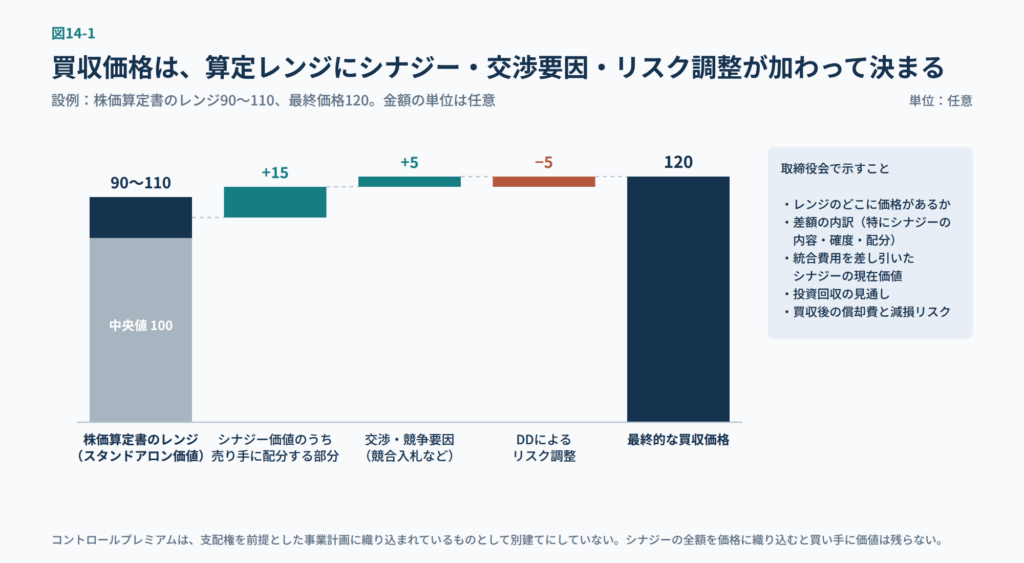
Figure 14-1 Decomposition of acquisition price (illustrative example). Amounts are illustrative assumptions. The control premium is assumed to be incorporated into the business plan under the DCF method and is not set aside separately.
| component | content | Evidence material |
| standalone value | The value created by the target company independently through its current management. Third-party stock price valuation range | Company profit calculation formula (DCF method / Similar company comparison method) |
| synergy value | Additional value created by combining with buyers (sales synergies, cost synergies, financial synergies) | Buyer's internal estimate. Specification of probability and timing of realization |
| control premium | Add-on to the ability to change management policy and increase value by acquiring control | Premium level for similar transactions. If the DCF method uses a business plan that assumes control rights, it is already factored in and will not be added separately (double addition). |
| Negotiation/competitive factors | Competitive bids, seller's asking price, and consideration for transaction certainty. | Record of negotiation history |
| risk adjustment | Off-balance sheet liabilities, contingencies, and reductions to working capital levels identified in DD | DD report, SPA price adjustment clause |
Of these, synergy value should be considered most carefully by the board of directors. This is because synergies that are factored into the acquisition price should be limited to those that are ``highly likely to be realized, can be quantified, and the timing of realization can be specified,'' and the extent to which the value of the realized synergies should be paid to the seller (synergy allocation) is a management decision itself.
Points to note when handling synergies
- Not pricing the full amount of synergies: Realizing synergies requires effort and cost (integration costs, system investments, staffing) on the part of the buyer. If the full synergy value is paid to the seller, the buyer is left with nothing. Therefore, in practice, it is common to negotiate with a certain amount of highly probable synergies as the upper limit.
- Check whether synergies are included in the DCF method business plan: For example, if the business plan presented by the seller already incorporates sales increases and cost reductions based on integration with the buyer, standalone value and synergy value will be double-counted.
- Subtract integration costs: The value of synergies is also evaluated at the present value, taking into account the one-time costs required to realize them and the time it takes to realize them.
- Assuming post-acquisition verification: The synergies demonstrated at the board of directors meeting will be verified as the achievement of business plans during post-acquisition impairment testing.
Concept of control premium in acquisition price and stock price valuation report
When acquiring listed companies, it is common to purchase them at a certain premium over the market share price, and this is sometimes called a control premium. When evaluating unlisted companies using the DCF method, business plans are created on the assumption that the company will be able to determine management policies as the controlling shareholder. Therefore, the control premium is often considered to be incorporated into the business plan, and in that case, adding the premium separately would result in double addition.
In addition, since there is some overlap between the improvement effects and synergies that can be realized by gaining control, when accumulating control premium and synergy value separately, make sure that you are not counting the same effect twice. When acquiring minority stock, the issue is the discount that comes from not having controlling rights. Therefore, please check in the valuation report whether the valuation is based on control (control basis).
How to explain the relationship between acquisition price and stock price valuation report at a board meeting
From the perspective of directors' duty of care as a prudent manager, it is important that there is a record of rational consideration of the appropriateness of the acquisition price. Therefore, assembling explanatory materials in the following order will help organize the discussion.
- First, the conclusion of the third-party stock price valuation report: the range of each valuation method and its assumptions (business plan, discount rate, similar companies).
- Positioning of acquisition price: Where is the acquisition price in relation to the calculation range? If the range is exceeded, the breakdown of the difference (synergies, competitive factors, etc.).
- Next, the content and accuracy of the synergy: the amount of each item, timing of realization, required investment, and department responsible for realization.
- In addition, risks and their reflection in prices: matters discovered in DD and treatment through price adjustments, representations and warranties, and indemnity clauses in SPA.
- Expected return on investment: payback period, IRR relative to the acquisition price. Impact on profit and loss after acquisition (amortization of goodwill and intangible assets, temporary impact on profit and loss immediately after acquisition).
- Finally, sensitivity analysis: the impact of unachieved business plans, unrealized synergies, and changes in discount rates on investment recovery.
In particular, items 5 and 6 provide evidence that the board of directors was aware of the post-acquisition impairment risk in advance. Therefore, in cases where the acquisition price significantly exceeds the standalone value, we recommend that you perform a rough PPA (pre-PPA) before the acquisition to show the impact of the scale of goodwill and amortization expenses.
Difference from fairness opinion
In large-scale projects involving listed companies or transactions where there are concerns about conflicts of interest (transactions between parent and subsidiary companies, MBOs, etc.), we may obtain a written opinion from a third party stating that the terms of the transaction are fair from a financial standpoint (a fairness opinion). On the other hand, while a stock price valuation report is a document that indicates a range of valuations, a fairness opinion is a document that expresses an opinion on specific transaction conditions, and the responsibility of the person providing the opinion is heavier and the costs are higher. A stock price valuation report is usually required for the acquisition of a business company, and whether a fairness opinion is required is determined based on the nature of the transaction, and if the company is a listed company, the rules of the exchange and the advice of a legal advisor.
Impact of acquisition price on post-acquisition accounting treatment
The acquisition price will be reflected in the post-acquisition financial statements as follows: Therefore, it is desirable for the board of directors to understand these factors when deciding on prices.
- Size of goodwill: The difference between the acquisition price and the market value of net assets after PPA is goodwill. Therefore, a price that significantly exceeds the standalone value directly leads to an increase in goodwill.
- Difference between IRR and WACC: In PPA, the IRR calculated backward from the acquisition price and business plan is compared with the discount rate (WACC). If IRR is significantly lower than WACC, it suggests that the acquisition price may include a premium that cannot be explained by the business plan. The presence or absence of an impairment loss is determined by comparing the recoverable amount of the subject unit, including goodwill, with the book value, so impairment is not determined solely by comparing IRR and WACC. However, it can be used as an indicator of the condition that is likely to lead to impairment losses if the business plan is not achieved.
- Amortization expenses: Under Japanese GAAP, amortization of goodwill and intangible assets, and under IFRS, amortization of intangible assets with finite lives will reduce operating income for several years after an acquisition.
- Impairment risk: If synergies or business plans are not achieved, goodwill impairment losses will occur. Additionally, the higher the synergy ratio in the decomposition of the acquisition price, the greater this risk.
summary
To summarize the relationship between the acquisition price and the stock price valuation report, the stock price valuation report obtained by the buyer often indicates the standalone value range of the target company, and the purchase price is determined by adding synergies, control premiums, negotiation/competitive factors, and risk adjustments. It is not a problem in itself that the acquisition price exceeds the calculated range, but it is important to clearly state the breakdown of the difference, especially the content, accuracy, and allocation of synergies, and to keep a record of the board's deliberations, including the outlook for investment recovery and impairment risk. Furthermore, since the acquisition price is reflected in the post-acquisition financial statements in the form of the size of goodwill, the relationship between IRR and WACC, amortization expense, and impairment risk, it is desirable to understand the impact of this at the price determination stage.
Things you can discuss with Keystone Advisory
At Keystone Advisory, in addition to creating stock price valuation reports for the board of directors, we also verify FA suggested prices (organize the breakdown of the difference from the calculation range). We support quantifying synergies and estimating integration costs, as well as simulating goodwill and amortization costs using estimated PPA before acquisition. In cases where the board of directors' meeting schedule is fixed, we will inform you of the scope of required materials and work period during the initial consultation. We also accept consultations at the stage of how to explain the difference between the acquisition price and the stock price valuation report.Contact formPlease contact us from.
References
Japan Institute of Certified Public Accountants “Corporate Value Evaluation Guidelines”
Accounting Standards for Business Combinations (Corporate Accounting Standards No. 21)
Writer
Kensuke Tanabe (CPA)
Keystone Advisory
Engaged in valuation/PPA work, statutory audits, and IPO support at Tohmatsu Audit Corporation and PwC Advisory. He assumed his current position after working as a director at a PE fund and an issuer at an operating company.
*This article is an explanation based on general practice at the time of writing. Please follow the circumstances of each company and the advice of your legal advisor when determining the appropriateness of prices and legal obligations for individual transactions.
